Sunday, 5 April 2015

Passover: Houevos Haminados / Marbled eggs

Passover and Easter more often than not, fall at the same time of year. Apart from its seasonal similarity there is also one other thing that the two festivals have in common. Eggs. 
Whilst Amir & I have been busy preparing food for passover, Dan has been enjoying Easter activities at school. These activities are centred around eggs. There is an Easter egg hunt where they search for chocolate eggs wrapped in colourful tin foil, there's the egg decorating competition and the egg rolling competition. According to google research, the egg symbolises "life" for the Christians to remember the Resurrection of Jesus after he was crucified. Eggs in the Jewish tradition however, represent mourning.
When I was a child and Easter fell at the same time as passover, I wasn't allowed to eat my chocolate Easter eggs until passover had finished, so my Mum would store them away in a cupboard until I was able to eat them. If only I had the same will power now, as I did then.
Houevos Haminados is I believe Ladino for baked eggs. I call them marbled eggs as that is the effect given after they've been cooked. Each one is unique in design and they are always a talking point at our passover meal. These eggs are supposed to be baked for hours and hours in the oven but here is the quick version which is just as effective.

The secret of this recipe is onion peel. You will need as much as possible, so start collecting it months before or perhaps ask your supermarket if you can collect some in a bag. There isn't a measurement of quantity needed. I use handfuls and handfuls.

Eggs (based on 10 eggs)
Onion peel (mostly red but mix in some brown)
1 small teaspoon of black pepper
salt
2 large tablespoons of oil

Place the onion peel in a saucepan
Bury the eggs inside the peel 
Add the oil and the seasoning
Cover with water so the eggs are just peeking
Cook for the longest possible time you can until the water has almost gone.
Whilst cooking, the eggs should crack from the heat, this is how the eggs get their marble effect. If you see that the eggs haven't cracked and the water has reduced a lot then tap each egg very lightly with a spoon, put a little more water and carry on cooking.


Eggs placed in saucepan ready
to cook.


Water reduced, white eggs turn red.

Chocolate Easter eggs - Simply no will power left!


Sunday, 29 March 2015

Passover and Prasinagua

Over the next couple of weeks I will be preparing dishes for Passover. I will post recipes as and when we make them. 
It's a very busy time in the kitchen as I like to prepare ashkenazi recipes that my Mother traditionally used to make and Amir likes to cook sephardi recipes from his side of the family. 

 Passover, a time for Jewish people to remember the liberation of slavery and to remind ourselves of the suffering endured. So, I am not sure if I am supposed to feel guilty or not by immensely enjoying all the traditional biscuits and cakes baked during this festival.


My Mother-in-law will be coming to stay with us in England for 5 weeks as she does every Spring and she will be bringing something with her of great importance. Prasinagua - the best translation of this I can give is 'green growing without water'. It's written in Ladino. As Yiddish is to the ashkenazi Jews, Ladino is for the sephardi Jews. In Istanbul, Amir's Mum will go by the edge of the road side to search for wild grass. She then picks the grass and dries it. When dry, she will make little parcels with the grass and bring them to England. It amazes me that she hasn't been stopped and searched by customs who may be under the impression that she is smuggling in weed or some kind of drug! 

On arrival at home in England the first thing she does is give all of us a little bundle of grass to put in our purses or wallets. She then scatters some of the dried grass all over the hallway by the front door and tells me not to clean it up for 24hrs! She has great pleasure in giving us the parcels of grass and tells the children every year that the grass will bring good luck and prosperity in to our lives. This grass grows wild and in abundance and shows the coming of summer and so with it, it will bring an abundance of luck and prosperity in to our home, inşallah, we hope.
In Greek the word prasino means green and one of the recipes we traditionally eat over passover is meatballs containing leeks. Leeks in Turkish is pirasa. So there is a connection with the meaning of prasinagua.
So, to all of you who celebrate Passover and all of you who don't, I wish you prosperity, luck and all good things to enter your homes and in to your lives.
I look forward to sharing our Passover recipes with you. XXXX


This is a bundle of grass still kept in my purse from last year.

*I will welcome any other information about prasinagua and please let me know if any corrections are needed.*

Tuesday, 17 March 2015

Pancar Yaprağı Böreği (Beetroot Leaf pie)

Let's take a look at the stereotypical Jewish Mother. Honest about their emotions, caring, compassionate, worrying, overprotective, neurotic, sometimes smothering (especially with kisses), double all of that and what do you get? The stereotypical Turkish Jewish Mother! and all of these unique qualities of the wonderful women that they are seem to become a reality over the dinner table.
Amir's Mum, who I adore and love very much works extremely hard preparing food. With no air conditioning in the house in Burgaz and the temperature soaring to it's heights outside, there she is, in the kitchen with a wooden spoon in one hand and a cigarette in the other wearing a loose cotton dress. Every so often she wets her face and hair to keep cool while the pots and pans simmer and steam.
8pm is dinner time. We have all returned from the club, showered and changed into comfortable clothes and ready to sit down for dinner. Amir's Mum asks for our plates one by one as she serves the meal that she had been preparing all morning. We wait for her to sit down herself before we start to eat.
I know, that in the corner of her eye she is watching us to see if we are enjoying the meal, if no-one speaks about how the food is the questions start......
"Nasıl?" (translated as how, how is it?)
"Güzel mi?" (Is it nice?)
"Niye yemiyorlar? Çocuklar sebze sevmiyor mu?" (Why aren't they eating? Don't the children like vegetables?)
At that point I explained that Serena and Dan didn't like to eat all vegetables, in fact most things green they tended not to eat. The worrying stage then sets in, "How are they going to grow? They are not getting enough vitamins." After the worry stage, comes the neurotic stage......."Take them to see a specialist, they are not eating properly, it's not normal". 

Now, I am pleased to say that my children eat most things, vegetables included. The beetroot leaf börek is a good way to introduce leafy vegetables. Perhaps it's the purple veins that run through the leaves that save them from being the dreaded totally green vegetable. 

The beetroot leaf  börek is sometimes made with filo pastry but to keep meals healthy I make it without so I wouldn't really consider it as a pie, more of a starter or side dish.
It's a great shame that grocery stores in England cut off the leaves of the beetroot before they display it on sale. Such a waste.


The following ingredients I would estimate as a portion for 4.

3 bunches of beetroot leaves (approx 400g)
50g Feta cheese
100g of grated hard cheese (I use cheddar)
3 tablespoons of oil
1 egg
1 heaped tablespoon of flour

Wash the leaves thoroughly the night before to enable them to dry.
Cut off the stalks and chop. Place in a bowl.
Add all the ingredients together and mush them up in the bowl by squeezing with your hands.
Oil the bottom and sides of an oven dish and flatten down till 1cm thick. (I use a dish approx 30x20cm)
Place in the oven at 180c and bake until it starts to go brown on top.
Cut and serve.
We love eating this with a dollop of natural yoghurt.


If beetroot leaves are too difficult to find. This dish is just as tasty using spinach leaves.


Wednesday, 11 March 2015

Midye Dolma (stuffed mussels)

My son Dan is a Burgaz boy. He adores everything about the island.  I think what he loves most of all is the freedom. I found it difficult to allow him to walk to and from home around the island on his own but I knew that from a young age children walked about unaccompanied. Two years ago, Dan begged me to let him walk from the house to the club on his own. It wasn't far at all and I knew that he was confident and was familiar with the route. I told Amir to follow behind him just to be sure. Off Dan went with his swimming gear in his back pack, all happy, stroking cats and dogs along the way down the road with Amir following him like a detective. When I finished what ever I needed to do at home, I went to the club to join them. I walked round to where the decking area is by the sea as that's where we usually sit. I put my bags down and looked around for Amir & Dan. I could see two bottoms sticking up in the air. I walked over and saw that the pair of bottoms belonged to them. They were both kneeling down and peeping through the tiny cracks of the decking. I asked what they were doing and they said they were looking to see if there were mussels. Amir then borrowed Dan's goggles and dived down beneath the decking. So, I joined Dan with my bottom in the air to look through the gaps of the decking to see if I could see him swimming beneath us. He was no-where to be seen. Amir then re-appeared with a hand full of mussels to take home. He had gone to a different area where the boats are to collect them.
Being raised in a Jewish family I was not introduced to seafood. It was a big no-no at home. My Mother told me that seafood is very unhealthy and you could get food poisoning from it so it always worried me when Amir would buy stuffed mussels from the street sellers. I had the devil on one shoulder telling me "try it...try it" and the angel on my other shoulder telling me not to eat it. The devil spoke louder and so I tried one of Amir's home made stuffed mussels and I've been eating them ever since.

There is a saying in French that all the months containing the letter R (September-April) are the best months of the year to eat mussels.


800g fresh mussels
225g rice (not basmati or jasmine)
100g chopped onion
125g currents
1 level teaspoon black pepper
(Amir likes it quite peppery as the street sellers make but personally I would use less)
1 and half heaped teaspoons of cumin
1 and half heaped teaspoons of cinnamon
Quarter of lemon juice
2 and half teaspoons sugar
salt to taste.
oil

Drizzle oil in the bottom of a saucepan and blanch the chopped onions until slight colour change and soft.
Wash the rice well and place in the saucepan.
Add all the other ingredients, add water to 1cm above rice level and simmer until rice is cooked. 
Leave to cool slightly.
Wash the mussels well in a colander.
The messy part.....
Prise the mussels open with a knife but leave the top half connected to the bottom half. You need to discard the beard (the hairy part inside the mussel.) 
When all have been prepared in this way take a mussel and tear off the top half. Scoop up the rice mixture into the bottom part of the mussel and sandwich it together with the top half. Press down and with your finger wipe around the edge where rice has oozed out.
Place neatly around the saucepan.
Pour water over the top to dampen (you can measure about a finger width of water in a glass) place saucepan on a low heat and steam for approx 10 - 15 mins.

When cooled, store in fridge. 
Serve cold with a drizzle of lemon juice.
Use the top half of the mussel as your spoon to scoop out the filling.


Sorry to disappoint anyone who wanted to see a photo of our bottoms in the air!


Sunday, 1 March 2015

Biscuit and Chocolate Pudding Cake


In the first few weeks of arrival to Istanbul I was probably at the height of gossip between Amir's friends and family. All wanted to meet me. Every few nights, Amir would tell me that we have been invited to someone's home. I quickly learnt to make sure I wore clean socks with no holes in as I would be expected to take off my shoes when entering in to some ones home. I would then be offered a pair of slippers to wear. I found it amazing that no matter whose home I visited everyone had a pair of slippers to fit. I looked around to see where  slippers of every size could possibly be kept but I could not see evidence of cupboards in the hallway large enough to store such a variety of slippers and sizes. I of course made every effort with my appearance when meeting Amir's friends and family for the first time and felt a little disappointed that I was forced to wear a pair of slippers that were very unattractive and didn't match what I was wearing.
Every home I went to was beautiful, simple and elegant, each piece of furniture looked like an antique to me and I was so cautious not to spill anything or leave any fingermarks on untouched glass. In my mind I questioned how tidy and precise all these homes were, no magazines lying around, no piles of paperwork in sight everything had it's place, even table cloths were artistically draped.
After the gossip had died down and everyone had met me on a number of occasions I started to notice something different about their homes, the chairs were not the same as I remember them to be, the sofas were not of the same colour and material as when I first saw them and then I found out why. Some Turkish people cover their furniture. Everyday, they live in their home without seeing the full beauty of their furniture as it is hidden underneath a cover. The reason for this is that with everyday life the furniture can be spoilt so to preserve its life, chairs and sofas are covered and only on the occasion of a special guest the covers are taken off . This bothered me a lot, especially at Sarika's home (Amir's Grandmother) her furniture was comparable to that in a museum, beautifully carved wood with regal style fabric was hidden under bland dark green covers. My argument was that she should enjoy looking at her furniture in all its splendour every single day. Perhaps, I am just as guilty at home in England but we do have an excuse, we have a large hairy Labrador living with us and I have gone to the extreme of even having a cover on top of the cover!
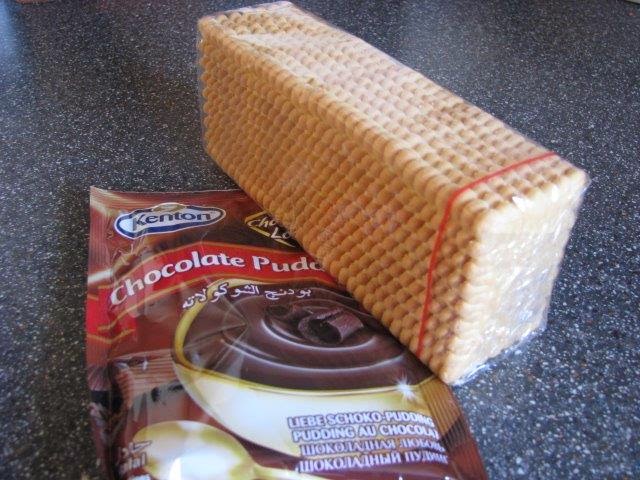
The recipe I have chosen to write about today is one that always impresses my guests, it gets a "WOW" when they see it. Just as I used to be when I was impressed as a guest myself. Little do they know what it is made from. When Amir's Mum first made it I could not understand what the ingredients were. I think this is referred to as the pyramid cake because in Turkish patisseries they make it triangular shaped. This is the fastest no bake cake ever, simply made with petit beurre biscuits and a ready chocolate pudding mix. Don't worry though, if you can't find the pudding mix in a shop I will give you the recipe at the end.


One packet of chocolate pudding mix
(This can be bought in Turkish supermarkets, any make is fine)
One packet of plain rectangular biscuits
(petit beurre is the type you can find in shops)
Milk (according to amount stated on the packet)

Follow the instructions on the pudding packet. It will usually be to empty the packet in to a saucepan and add milk, the packet I used today instructed to use 500ml milk.
Stir constantly until bubbling. Mixture will become thicker when boiled.
Leave to cool slightly, it will then thicken even more. Stir again.
Place your biscuits and pudding mix in front of you together with a long plate to serve on.
Spread pudding mix on one side of one biscuit, then place another biscuit on top as if to sandwich it. Then place upright on your serving plate until all biscuits have been sandwiched together. The remainder of the chocolate can then be spread with a knife all over the biscuits to completely cover.
Place in fridge to set.
EACH SLICE MUST BE CUT DIAGONALLY TO REVEAL STRIPES!
I made this one a few months ago and decorated it with strawberries. You can also place slices of banana in between.


This is the surprise. Cut diagonally across the cake and each slice will be served with stripes!

If you can't find pudding mix in the shops, here's the recipe:
For two packets of biscuits you will need
4 cups milk
2 tablespoons of cocoa powder
6 tablespoons of sugar
3 tablespoons flour
1 egg
1 packet of vanilla powder
Put all ingredients in a saucepan and heat. Keep stirring until the consistency is thick.
Leave to cool for about 20 minutes then you can sandwich the biscuits as above.

TIP: If your consistency is not thickening quickly enough  you can add cornstarch. It needs to be able to be poured but on the border line of plopping off of the spoon!
If you find your biscuits are not balancing upright you can lay them flat and create layers of chocolate / biscuit / chocolate etc.
Bananas are lovely to put inside if you are making it in a dish.
You can sprinkle the top with coconut or ground pistachio nuts.


Saturday, 21 February 2015

Poğaça (savoury pastries)

We have a saying, when in Rome, do as the Romans do. I knew that if I wanted to survive in Turkey I needed to learn the language as soon as possible. I found a beginners course at Bosphorous University. It was not only interesting to learn the language but socially stimulating as I had the wonderful opportunity to meet other people from all over the world like myself, starting a life in Turkey. Some were there on business, some married to Turkish wives or husbands. What ever their reason for joining the language class, we all  understood each others isolation and frustration. I particularly connected with two girls, Judith from South Africa and Sue, from the Bahamas. Together, we ventured through Istanbul finding our way around, practising the Turkish we had learnt. Sue & I especially spent a lot of time together. I can honestly say that I wouldn't have survived with out her. We shared moments of tears  and good times with much laughter. 
I travelled to the university by bus and on many occasions had my breakfast en route. Poğaça (poh-ah-cha) is a popular, fast way of eating breakfast. These savoury plump pastries are both satisfying and tasty, they can be eaten plain or with a cheese filling. They are usually sold on the streets in mobile glass containers with an umbrella erected above. The word Poğaça was always a challenge for me to pronounce and in the beginning I didn't have enough courage to walk up to the man selling them. However, over time I felt more and more confident to speak Turkish and even though I still had that English twang of an accent that wasn't the thing that gave me away as being foreign. It was when I said "Lutfen" (please). Yes, that's when I got the strange look from the Poğaça seller. "Bir tane peynirli lutfen", "one with cheese please" I would ask. Lutfen, is hardly used when asking for something,  I can't help myself, In English we say please and thank you simultaneously. So, when in Rome, I do as the Romans do, but with a please at the end!


I choose to use mahlep in this recipe, I love the aroma and taste of this spice and use it in cakes and biscuits also. It's made from the seeds of a special sour cherry and has a nutty flavour perhaps the equivalent to nutmeg. It is also known as mahlab in other countries. It can be bought in Asian and Turkish shops here.
125g Feta cheese
Parsley (just a handful)
100g soft margarine
75ml oil
75ml milk
1 teaspoon of baking powder
1 teaspoon of mahlep
300g plain flour (sieved)
pinch of salt

1 egg (for glazing only)

Make the filling first by mashing together the feta cheese and parsley in a bowl.
Now for the dough:
In a saucepan, warm the milk slightly.
Then, pour it in to a bowl together with the margarine, oil, baking powder and mahlep. Sieve the flour into the bowl & add the salt.
Knead mixture together until dough is firm and smooth.
This mixture makes approximately 12 so divide the mixture in to 12 equal balls.
Take a ball of dough and flatten with your hands into an oval shape. Dough should be thin, certainly no more than 5mm thick.
Take a small quantity of the cheese mixture and place it in the middle of the oval. Fold the side over and pinch at the edge. You can make circle shapes if easier, just bring the edges up to meet like a little parcel.
Use the yolk of the egg to glaze all around the top of the parcels.
Sprinkle with poppy seeds or sesame seeds if you prefer.
Leave the pastries to rest for at least half an hour before placing in to the oven at 175 and bake until glazing is dark golden brown.

(I baked these today. I think perhaps my pastry was slightly too thick but never the less, they were tasty.)

Saturday, 14 February 2015

Enginar (Artichokes)

City life took a lot of getting used to but I found it vibrant and exciting. During the winter months, we lived in Şişli, a very congested area in Istanbul. Our apartment was one of many sandwiched along a street without a pathway. I  regularly gazed out of the window watching pedestrians dodging the traffic as they walked in the road. 
One day, when I stood by the window, a woman in the apartment directly opposite caught my eye. She opened the window and started to climb outside. Whilst balancing on the window ledge she held on to the window frame with one hand. I started to panic, I thought I was going to be a witness to a suicide attempt. Then, she pulled out a cloth and started to clean the window. I couldn't believe my eyes. Cleaning ladies from Turkey must be the bravest and most skilful.
Along with the visual entertainment of our busy street I embraced the sounds that accompanied it. "Enginar (en geh nar), enginarci" a man yelled on a daily basis. Feeling relieved that the man was not in search of a long lost relative called enginar, I learnt that he was selling fresh artichokes.  A basket appeared from no-where tapping against our living room window as it descended. I rushed to see where it was coming from. As I stretched my neck to look above me, I saw a woman leaning out of her window levering  the basket by string very slowly to the street below where the man was standing. He put some artichokes in her basket and  then the woman  pulled  the string back up towards her as the basket banged against our window again . 
When the children were young, I  practised this basket manoeuvre in our home asking the  children to place their toys in the basket whilst I pulled it upstairs to their bedroom. It didn't last very long!

Enginar is a seasonal vegetable in Turkey. It's difficult to find decent fresh ones in England so Amir buys them uncooked and preserved in a jar from the local Turkish supermarket. There are a few different ways of cooking them. This is the traditional Turkish way, eaten as a meze (starter) or a vegetable accompaniment. 


4 large or 8 small uncooked artichoke cups
100g peas
1 large potato 
2 medium carrots
8 onion shallots or 1 onion (optional, I don't use)
half a small squeezed lemon
100ml oil
2 and a half heaped tablespoons of sugar
salt to taste
1 tablespoon of chopped dill

If you are using artichoke cups from a jar, they will need to be drained.
Dice the potato and carrots, slice the onion if you are going to use.
In a saucepan place the oil and diced vegetables and start to simmer for 5 minutes.
Add artichokes and peas. Cover with water and cook for 5-10 mins.
Add lemon, sugar and salt and cook for a further 10 mins.
Add dill.
Simmer in the pan until water has reduced and you are left with just enough sauce for the vegetables to lay on and artichokes should be soft.
Serve chilled or my preference is at room temperature.


The other way of cooking artichokes is classed as the Turkish Jewish way (seferadi). Cooked in a rich lemon sauce.
It is the same as the above minus the extra vegetables. 
Cook the artichoke cups in the oil, water and lemon juice adding the sugar and salt. The liquid will reduce to make a nice tangy sauce.


Before meeting Amir I had never eaten an artichoke. There are many other English people that are not familier with this vegetable and how to cook it. If you buy it fresh from the supermarket I can guide you through how to cook it. You can even eat the stalk and part of the leaves!